

Healthcare6 minutes read

    Remote Physiotherapy App Development: A HIPAA-Compliant Wearable MVP in 6 Months

    A Dallas digital health startup needed a compliant MVP for personalised rehab at home. In 6 months, the team shipped a patient app, a therapist web app and wearable-sensor tracking. Therapists now adjust each plan from real joint motion data.

    Industry
    Digital health, physiotherapy
    Delivery
    MVP in 6 months, then product evolution
    Team
    13 people, incl. a compliance consultant
    Platform
    Mobile app, web app, wearable sensors
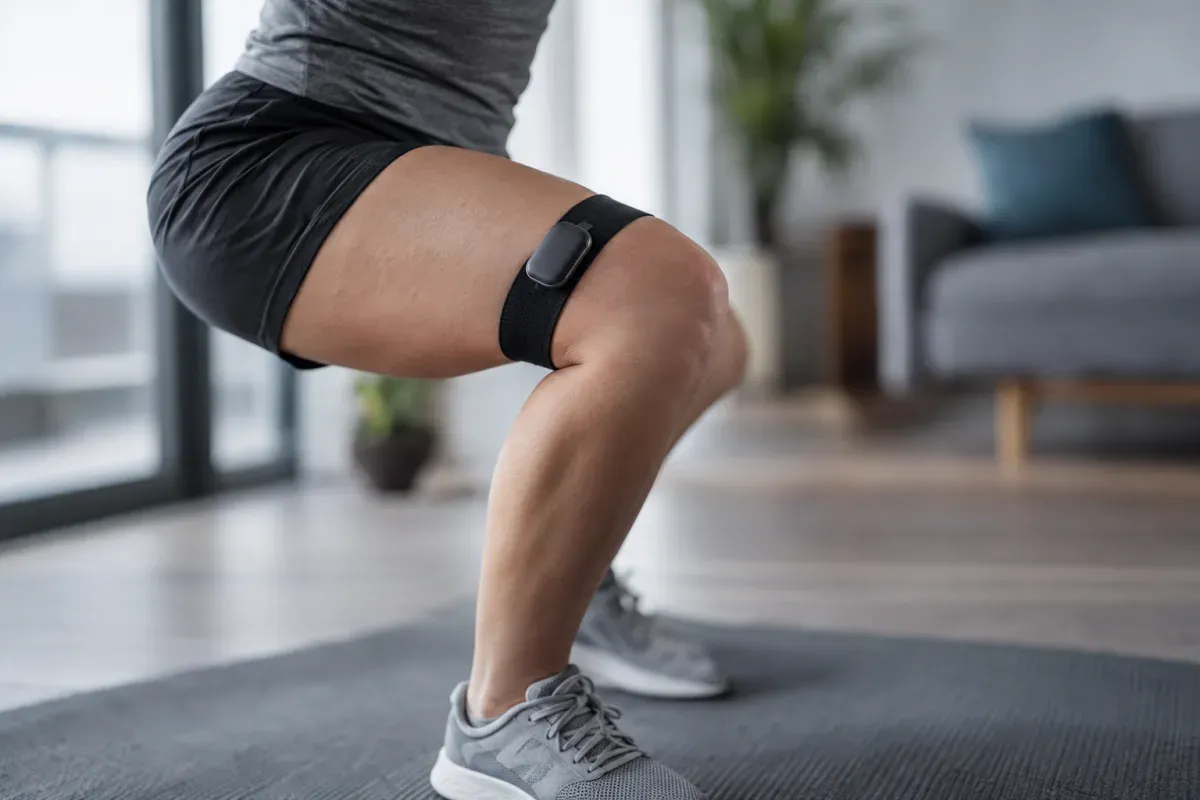
    Patient with a wearable knee sensor during a session supported by remote physiotherapy app development
    Wearable sensors give therapists objective joint motion data between visits.

    Project overview

    Physical rehab is hard to personalise. It is even harder to track once the patient leaves the clinic. A Dallas digital health startup wanted fully personalised remote physiotherapy, and this remote physiotherapy app development project turned their care model into a working product.

    The platform has three parts: a cross-platform patient app, a web app for therapists and admins, and a HIPAA-compliant back end on AWS. The apps read Xsens DOT wearable sensors to measure joint range of motion and show therapy progress. A fully functional MVP was ready within 6 months.

    The challenge: personalised rehab outside the clinic

    The founders saw clear drawbacks in traditional rehab. They wanted exercises and progress tracking for each patient in one digital platform.

    Their care model mixes offline and online rehab. A therapist assesses the patient in person first. After that, the therapist gives continuous online feedback and adjusts the program to the patient's performance.

    That model needs objective data: how far a joint moves today, compared with earlier readings and the target. So the product had to join wearable sensors, a patient app, a therapist web app and a back end built for protected health information. The first goal was an MVP that real users could try.

    Physical therapist reviewing patient progress on a tablet in a clinic office
    Therapists adjust each plan from sensor readings, not guesswork.

    Our approach: research, requirements and a HIPAA-compliant design

    A 13-person team covered product, compliance and engineering: a project manager, a business analyst, a regulatory compliance consultant, a UX/UI designer, 2 Xamarin developers, 2 front-end developers, 4 back-end developers and a QA engineer. It drew on our healthcare software development practice.

    1. 1

      Market and user research

      The team analysed the market and competing products, interviewed stakeholders and studied patient needs.

    2. 2

      Requirements and feature priorities

      Research turned into requirements. The team mapped out the features and prioritised them for the MVP.

    3. 3

      HIPAA-compliant architecture

      Software engineers designed a HIPAA-compliant architecture for the platform, with a regulatory compliance consultant on the project team.

    4. 4

      MVP build and release

      The team built the patient app, the platform and the web app for admins and therapists. The fully functional MVP went to users, and their feedback shaped the next stage.

    5. 5

      Product evolution

      After that feedback, the startup entrusted the software evolution to us: better sensor algorithms, stability work, UI changes and performance fixes.

    What we built for patients and therapists

    Every feature serves one goal: rehab fitted to each patient on a remote physical therapy platform.

    • 01

      Personalised therapy plans

      Physical therapists create an in-app plan for each patient. The patient knows what to do, and the therapist can change the plan as progress data comes in.

    • 02

      Exercise video instructions

      Detailed video instructions show patients how to perform each exercise at home.

    • 03

      Progress reports

      Patients and therapists see sensor range-of-motion data, program completion stage, minutes spent exercising, completed sessions and session history.

    • 04

      Instant messaging

      Text chat between patients and therapists keeps feedback continuous between in-person visits.

    • 05

      Educational content

      Articles and videos on musculoskeletal therapy help patients understand their condition.

    • 06

      Therapist and admin web app

      A complementing web app gives admins and therapists access to the platform, where therapists create plans and review progress data.

    Architecture: one data flow from sensor to therapist

    The wearable sensors stream joint readings to the patient app. The app turns them into range-of-motion values and sends them to the back end. Therapists see them in their web app next to the patient's plan and history.

    The patient app is a cross-platform mobile app development build, so one codebase serves both phone platforms. The therapist web app and the back end come from our Angular development company and Node.js development company teams. On AWS, compute runs the back end and the web app, and storage holds the library of exercise videos and images.

    Data is encrypted on devices and on AWS, and every transfer runs over SSL. If you are scoping a HIPAA-compliant physiotherapy app, the HHS overview of the HIPAA Security Rule lists the safeguards expected for electronic health data.

    Engineering challenge: accurate range-of-motion measurement

    Challenge. Therapists can only adjust a plan if the range-of-motion (ROM) readings are accurate. The vendor's default Xsens DOT motion capture algorithms were not tuned for the joints this care model tracks.

    Decision. The team proposed proprietary algorithms built for knee joints and low back mobility, the two areas the startup treats.

    Implementation. The app measures a joint's ROM, then compares it with the patient's earlier readings and the therapist's target. After user feedback on the MVP, the team also improved algorithm stability, app performance and the UI, and fixed two issues that hurt measurements:

    • Sensor connection and data streaming stability
    • Patient orientation in space affecting measurement accuracy

    Wearable data in everyday rehab

    Wearable motion sensor on a knee measuring range of motion during home physiotherapy
    Outcome: therapists see readings they can act on, judge progress and adjust the program while avoiding pain and injury.

    Results for patients and the business

    The startup got a ready-to-market MVP and kept evolving the product with us. Users of the platform reported the outcomes below; the measurement method, sample size and period were not published.

    Pain reduction
    71%
    Reported by users of the platform.
    Fewer unnecessary surgeries
    70%
    Reported by users of the platform.
    Less medication consumption
    52%
    Reported by users of the platform.

    Related work: connected rehab hardware

    Sensor-based rehab is a field we know well. On the connected rehabilitation platform, four motion sensors on a slant board stream live data to clinicians, with software documentation prepared for an FDA 510(k) submission.

    The difference: that project turned custom hardware into a clinical product, while this one built a home-care product on off-the-shelf wearables. If your product sits between the two, the healthcare software development team can map the fastest route to an MVP.

    Remote physiotherapy app development FAQ

    Can you integrate wearable motion sensors into a physiotherapy app?

    Yes. This platform reads Xsens DOT wearable sensors to measure joint range of motion. The team replaced the vendor's default algorithms with ones built for knee and low back mobility. It then fixed sensor connection, data streaming and patient orientation issues that affect accuracy.

    How long does it take to build a remote physiotherapy MVP?

    This one took 6 months to a fully functional MVP. That covered market and user research, requirements, a HIPAA-compliant architecture, and the patient app, platform and therapist web app. Your timeline depends on the number of platforms and how custom the sensor work is.

    How much does physiotherapy app development cost?

    It depends on scope: the number of platforms, sensor integration, custom algorithms and compliance needs. The fastest way to a reliable estimate is a short discovery of your care model and feature priorities. That is how this project started.

    How do you keep a physiotherapy app HIPAA-compliant?

    A regulatory compliance consultant worked on the team from the start, and engineers designed the architecture to be HIPAA-compliant. Data is encrypted on devices and on AWS. Every data transfer runs over SSL.

    What does the architecture of a remote physio platform look like?

    Here it has three parts. Wearable sensors stream to a cross-platform patient app, which computes range of motion. A back end on AWS stores the data and the exercise media. A web app lets therapists build plans and review progress.

    What team does a project like this need?

    This one had 13 people across product, compliance and engineering: a project manager, a business analyst, a compliance consultant, a UX/UI designer, 2 mobile developers, 2 front-end developers, 4 back-end developers and a QA engineer.

    Do you support the product after the MVP?

    Yes. After user feedback on the MVP, the startup entrusted the software evolution to us: better motion algorithms, stability and performance work, and UI improvements. If you need extra capacity instead, you can [hire Node.js developers](/hire-nodejs-developers) for your back end.

    Technology stack

    Mobile

    • Xamarin
    • C#

    Web and back end

    • AngularJS
    • Node.js

    Cloud

    • Amazon EC2
    • Amazon S3

    Wearables and IoT

    • Xsens DOT sensors
    • Custom ROM algorithms

    Security

    • Data encryption at rest
    • SSL
    • HIPAA-compliant architecture
    View all
    Intelligent Observability Platform for Enterprise IT Operations
    IT Operations

    Intelligent Observability Platform for Enterprise IT Operations

    A next-generation intelligent observability platform that delivers real-time visibility across IT, IoT, OT, applications, services, and telecom circuits. Scans 10 billion public IP addresses continuously, processes up to 100 billion data points simultaneously, and deploys in minutes instead of weeks.

    7 minutes readRead more →

    Planning a remote physiotherapy or wearable rehab app?

    We can take your care model to a HIPAA-compliant MVP, then make the sensor readings accurate enough for therapists to act on.