Healthcare6 minutes read

    Connected Rehabilitation Platform: From Sensor Prototype to FDA-Ready MVP

    A sensor slant board prototype became a connected rehabilitation platform: mobile and web apps for clinicians and researchers, an AWS back end, stable Bluetooth data and a software package ready for FDA 510(k) submission.

    Industry
    Healthcare, medical devices
    Engagement
    MVP, firmware to FDA documentation
    Platform
    iOS, Android, web, AWS
    Clinician tracking a slant board stretching session on a phone with the connected rehabilitation platform
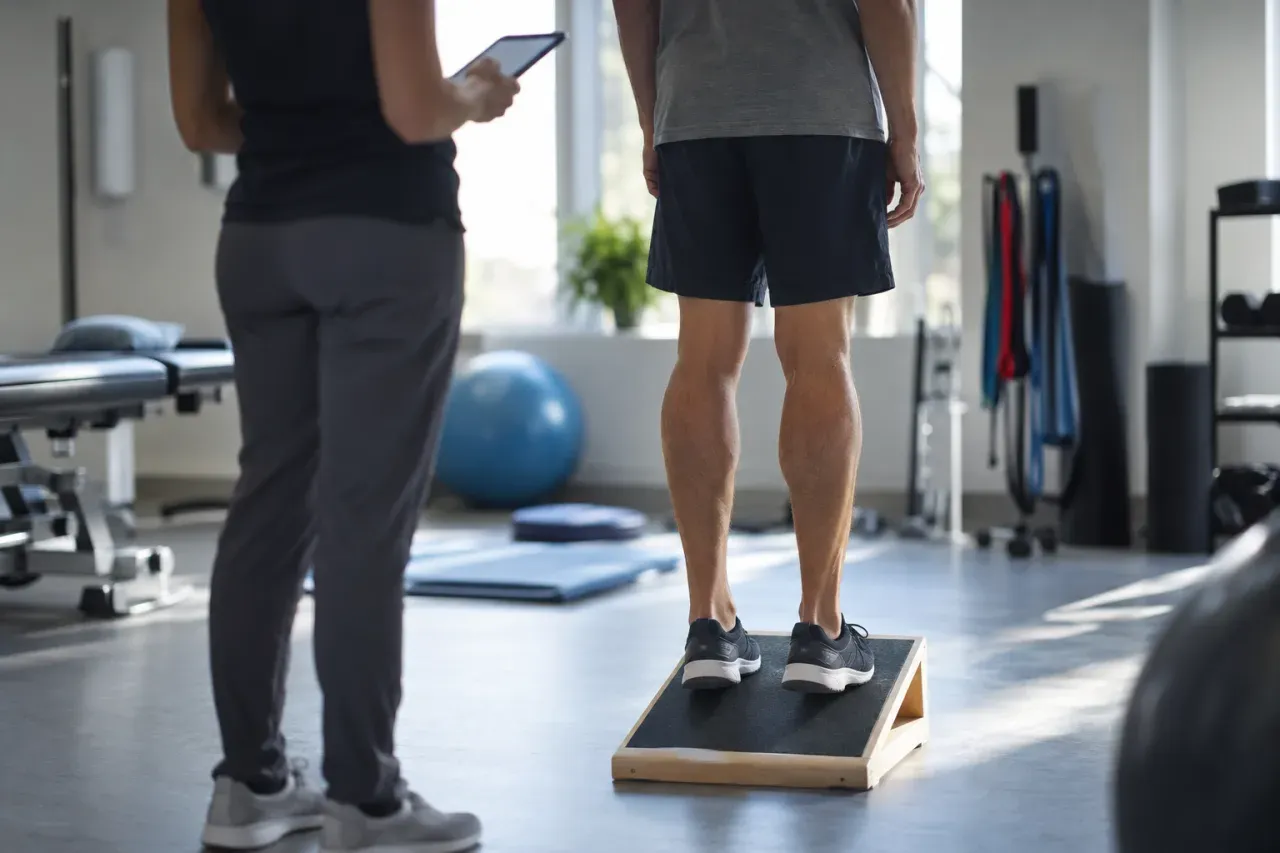
    Clinician-guided stretching sessions, measured in real time instead of judged by eye.

    Summary

    Rehabilitation still leans on the eye of the clinician. Range of motion is often judged visually, which makes progress hard to measure and harder to compare. A medical technology startup in Illinois, founded by a board-certified orthopedic surgeon with over 30 years of clinical experience, set out to change that with a smart slant board.

    They had a working hardware prototype. What they needed was everything around it: firmware, mobile and web apps, cloud infrastructure and the regulatory paperwork. We built that connected rehabilitation platform as an MVP fit for clinical validation and investor demos.

    The challenge: turning a prototype into a product

    The startup designed a slant board with four motion sensors, placed behind the knees and under the heels. Together they capture dorsiflexion range of motion, joint mobility and indicators of posterior chain tissue behavior while a patient stretches. The in-house team had built the prototype from off-the-shelf parts and lined up a third-party manufacturer to scale it.

    A board alone is not a product a clinician can use. It needed custom firmware, apps that make the data readable at the point of care, a secure back end and documentation the FDA would accept. The deadline was tight, and the MVP had to work in real clinics and impress investors.

    We assembled a cross-functional team: a project manager, a compliance officer, a business analyst, a UI/UX designer, iOS and Android developers, back-end and front-end developers, a C++ engineer, DevOps specialists and QA engineers. If you are staffing a similar build, the mix matters as much as the headcount.

    Engineer's workbench with an opened sensor slant board, laptop and smartphone during firmware testing
    Firmware and hardware work happened side by side with the app build.

    How the connected rehabilitation platform was delivered

    Each phase answered one question before the next began: does the concept work, is the data reliable, can clinicians use it, and is it ready for regulators?

    1. Phase 1

      Proof of concept on iOS

      iOS was chosen first because it is common among rehabilitation clinicians. A lightweight app connected to the board over Bluetooth, captured raw mobility data and computed preliminary dorsiflexion metrics. The startup used it to validate the idea with stakeholders and investors.

    2. Phase 2

      Fixing unstable sensor data

      Early tests showed dropouts. The cause was interference from nearby wireless networks and noise in the device wiring. Our engineers modified the board with filtering and electrical isolation, and sessions began to run reliably at home and in clinics.

    3. Phase 3

      Core clinical features

      The iOS app gained patient profiles, automatic device pairing and live mobility metrics. Web interfaces followed for clinicians and researchers, backed by AWS.

    4. Phase 4

      Full MVP scope

      As the pilot entered real-world testing, the team added security controls, trend dashboards, guided session materials, PDF reports, an Android app and admin tools.

    5. Phase 5

      FDA preparation

      Our compliance specialist assembled the software documentation for the 510(k) pathway and guided the startup through FDA expectations for connected devices.

    What clinicians, researchers and admins get

    • 01

      Live session metrics

      During 1 to 5 minute sessions, the app shows maximum, minimum and average knee and ankle angles for each leg, plus angle dynamics in real time.

    • 02

      Optimal flexibility angle

      Each session produces its own optimal flexibility angle, a starting point for future load planning and individual rehabilitation programs.

    • 03

      Patient lists and trends

      Clinicians manage patient lists and follow historical trend dashboards across rehabilitation sessions.

    • 04

      Guided sessions

      Visuals and descriptions walk patients through each stretch, so execution is consistent from one session to the next.

    • 05

      Clinician and researcher portals

      Clinicians review patient-specific results on the web. Researchers export aggregated, de-identified data for scientific work.

    • 06

      Reports and admin tools

      Session reports export to PDF. Admins centrally manage hospitals, users and the devices connected to the platform.

    Why calculations run on the phone

    A key design question was where to process sensor data. The answer shaped cost, complexity and how the app behaves in a clinic with poor Wi-Fi.

    OptionStrengthsDrawbacks
    On-device calculation, AWS for routing and storageRecommendedLess system complexity, lower cloud load, responsive sessions even with limited internet. Modern phones handle real-time sensor math without tradeoffs.Not suited to large-scale retrospective analytics on the device itself.
    Cloud-side calculationCentral processing suits heavy analytics over large historical datasets.Adds complexity and cloud cost, and live sessions depend on a steady connection.

    Because the calculations use only real-time sensor data, the phone was the right place for them. The AWS back end handles session data routing and storage.

    Security and FDA readiness built into the MVP

    Connected medical devices draw scrutiny on both data security and documentation. These controls and deliverables were part of the MVP scope, not an afterthought.

    • Multifactor authentication with time-based one-time passwords
    • Automatic logoff on idle sessions
    • Audit logging of user activity
    • Encrypted connections between the board and the app
    • De-identified data export for researchers
    • Cybersecurity file prepared for the FDA
    • Software risk management plan
    • Practical guidance on FDA expectations for connected healthcare products

    As of February 2026, the startup is preparing its 510(k) pre-market notification.

    The team ramped up quickly and was not afraid to challenge our early assumptions. They helped us refine the scope, focus on what mattered for an initial release, and avoid spending time and money on features that were not critical yet.

    Founder and CEO, US medical technology startup

    Lessons if you are planning a connected medical device

    Test the radio link early. The proof of concept surfaced the Bluetooth problem before any clinical feature depended on it. The hardware fixes are now slated for the full product line.

    Decompose features ruthlessly. Prioritizing what the first release truly needed kept software costs down. When testing raised new considerations, the scope moved without losing momentum.

    Start compliance work with the code. Writing the cybersecurity file and risk management plan alongside development meant the FDA package was ready when the product was. The FDA's premarket notification 510(k) guidance is a useful starting point.

    The web portals run on React.js and the back end on Node.js. If you need the same skills, you can hire React.js developers or work with our Node.js development company team. More builds like this one are in our case studies.

    Researcher reviewing de-identified rehabilitation session data exported from the connected rehabilitation platform
    Researchers export aggregated, de-identified session data for scientific study.

    Questions about building a connected rehabilitation platform

    Why build iOS first instead of both mobile platforms at once?

    iOS is expected to be the most common platform among the target clinicians in physical rehabilitation. Starting there sped up the first delivery. The Android app followed once the core features were proven.

    How did you fix unreliable Bluetooth data from the sensors?

    The root cause was interference from nearby wireless networks and noise in the device wiring. Our engineers modified the board hardware with filtering and electrical isolation, which made test sessions reliable at home and in clinics.

    Does the app need internet during a session?

    No stable connection is required for the calculations. Key metrics are computed on the phone, while the AWS back end handles data routing and storage. That keeps the app responsive where connectivity is limited.

    Can you help with FDA documentation for the software?

    Yes. On this project our compliance specialist assembled the cybersecurity file and software risk management plan for the 510(k) pathway, and guided the client on FDA documentation requirements.

    How do you keep MVP costs under control?

    Through feature decomposition and prioritization. We challenged early assumptions and focused on what the first release needed. If you have a similar product in mind, [get in touch](/contact).

    Technology stack

    Mobile

    • Swift
    • Kotlin

    Web and back end

    • React.js
    • Node.js

    Firmware

    • C++

    AWS cloud

    • Amazon ECS
    • Amazon ECR
    • Amazon Aurora PostgreSQL
    • Amazon CloudFront
    • Amazon Cognito
    • Amazon ElastiCache
    • AWS Lambda
    • Amazon SQS
    • Amazon SES

    Infrastructure as code

    • Terraform
    View all
    Intelligent Observability Platform for Enterprise IT Operations
    IT Operations

    Intelligent Observability Platform for Enterprise IT Operations

    A next-generation intelligent observability platform that delivers real-time visibility across IT, IoT, OT, applications, services, and telecom circuits. Scans 10 billion public IP addresses continuously, processes up to 100 billion data points simultaneously, and deploys in minutes instead of weeks.

    7 minutes readRead more →

    Planning something similar?

    Tell us where the work is stuck today. In one call you get a senior engineer's view of the approach, the risks worth planning for, and a realistic first release.